AI-Powered Legal Analysis
The 4-hour mechanical pass becomes a 20-second machine read. Every issue ranks by risk. Every risk cites the offending clause and the page it lives on. The associate stays the lawyer; the machine stays the second pair of eyes.
With most AI the default state is exposure. With REDLINE the default state is containment.
Institutional-grade AI analysis with human oversight. The data never leaves the building. It does not even hit the internet.
Mathematical data sovereignty. Enterprise AI at small-firm prices.

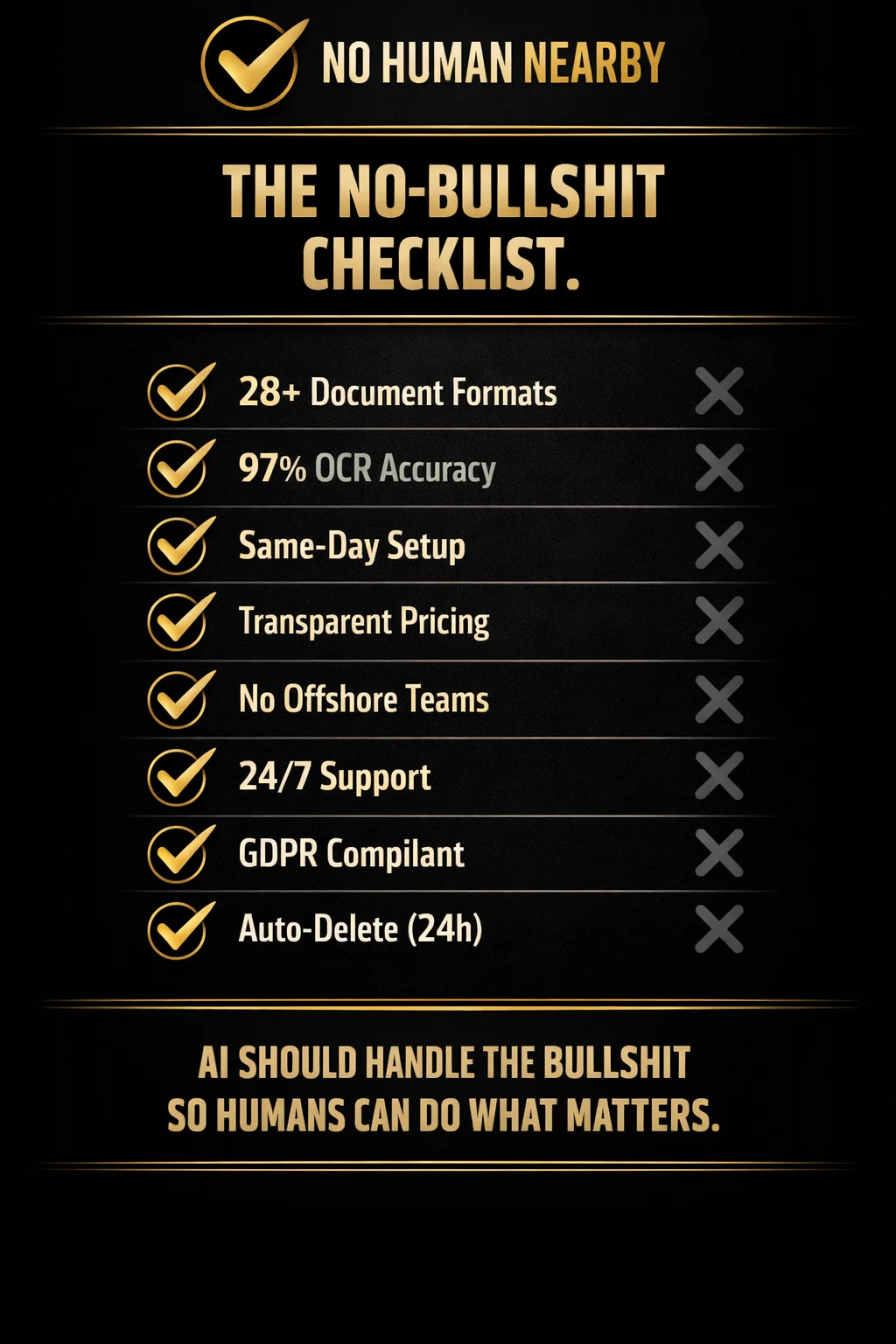
28+ FORMATS, ONE DROP
PDFs, scanned faxes, DOCX, Outlook archives, markdown, emails - Redline extracts and analyzes everything in one pass. Most competitors handle 4-6 formats. Redline handles 28+ including ZIP archives of mixed documents.
YOUR FIRM'S PLAYBOOK, AUTOMATED
Select your firm's playbook. Redline compares every clause against your accepted language, side-by-side. Green for matches, orange for deviations, red for missing critical provisions. The enterprise hook your associates have been waiting for.
Recorded demos with realistic data. Live system uses your firm's data and your firm's playbook.
The check gets written for the speed today. The renewal gets written for the moat tomorrow. REDLINE delivers both, in that order.
Day One
Drop a contract, get a 20-second risk-ranked review. Every flagged issue cites the clause and page. Every clause is cross-checked against the firm's standard playbook the moment the appliance plugs in. Out-of-the-box performance is the same caliber that retail cloud-AI tools deliver in 4 hours.
What you get: attorney-grade flagging on day one with zero training data, zero tuning, zero firm-specific configuration.
Month 6
Six months of review history teach the appliance which clauses your senior partners actually flag, which counterparty patterns repeat, and which fallback positions the firm reaches for. The first-pass shortlist starts to look like the partner's own annotations.
What you get: the same speed plus partner-shaped relevance. The associate fixes fewer false flags. The partner trusts the shortlist more.
Month 24
Two years of accumulated firm-specific intelligence is a moat the cloud-AI vendors cannot rent and cannot replicate. The hyperpersonalized review intelligence sits behind your firewall, on hardware you own, on a network you control. The partner's edge compounds inside the vault.
What you get: the moat. The same 20-second pass plus accumulated firm IQ that no competitor can buy access to.
"The moat is not the code. The moat is the hyperpersonalized intelligence safely accumulated behind the firm's own firewall."
Every hour spent on contract review is an hour not spent on high-value legal work.
Associates spend 2-4 hours reviewing a single contract. At $400/hour, that's $800-1,600 per review that could be allocated to strategic work.
Fatigue leads to oversights. A buried indemnification clause at 11pm could expose your client to millions in liability.
Different associates flag different issues. Without standardized review protocols, quality varies dramatically across your firm.
Every contract your associates review is money on the table. Here's what you're actually paying.
One junior associate reviewing 10 contracts a month costs your firm $16,000. REDLINE replaces that entire line item and returns analysis before the coffee gets cold.
Institutional-grade analysis, delivered in minutes.
Our AI examines every clause against 50+ risk factors, identifying issues that human reviewers might miss.
Every finding is verified by a trained reviewer. No hallucinations. No false positives delivered to your desk.
Receive client-ready PDF reports with risk scores, specific concerns, and actionable recommendations.
A quiet new risk is showing up in 2026 contracts - and most review tools aren't looking for it.
Vendors, SaaS providers, and platforms are slipping language into agreements that grants them the right to train AI models on your client's data, work product, and communications. Buried in Section 12.4. Referenced by defined term. Often indistinguishable from standard data-use language at a glance.
REDLINE flags every one. Our analysis engine specifically hunts for training-rights language that competitors treat as boilerplate - because in 2026, it isn't.
REDLINE's Own Contractual Guarantee
REDLINE's standard enterprise agreement contains an explicit clause committing that No Human Nearby will never train any model, aggregate any dataset, or improve any product using content or metadata from your firm's documents. This is not a policy. This is not a promise. It is a contractual obligation carrying the same weight as the firm's own confidentiality covenants.
Why Bloomberg Law, Westlaw, and Hyperdraft cannot match this: their terms of service require customer data to be ingested into centralized, multi-tenant models. Structural, not optional. Removing the training-rights clause would require abandoning their core business model.
Mathematical data sovereignty, reinforced by contractual privacy guarantees, layered on top of firm-specific institutional knowledge. See how the playbook compounds →
Lawyer+ is the entry architecture. Not the ceiling.
Today, REDLINE accelerates the mechanical portion of contract review. The human attorney remains the final arbiter of every decision. This is deliberate. The malpractice framework the legal industry has underwritten for 50 years assumes a licensed attorney is the decision-maker, and REDLINE is built to fit inside that framework, not around it.
As a firm's REDLINE deployment learns the firm's playbooks over 12 to 24 months (see the Playbook Moat writeup), the local model becomes progressively more capable of autonomous first-pass drafting on routine contracts. Routine NDAs, standard vendor agreements, boilerplate employment documents. Partner-level work stays with partners.
The lawyer+ positioning preserves the firm's immediate comfort and maintains the unbounded upside. The navigation system gets better as it learns your routes. The human is still driving the car.
We hear this question a lot. Here's why browser AI is a liability waiting to happen.
Browser AI sends your client's contracts to third-party servers. Every NDA, every M&A document, every settlement agreement - sitting on someone else's cloud.
When opposing counsel asks in discovery "Did you share privileged documents with third parties?" - what's your answer?
Our system keeps data on YOUR infrastructure. That's privilege protection.
Browser AI chat history disappears. When the bar or a client asks what AI reviewed their documents and what decisions were made - do you have receipts?
ABA Formal Opinion 512 requires you to understand where client data goes and maintain oversight of AI tools.
We log every action, every AI output, every human decision with timestamps. Full compliance documentation.
Browser AI gives answers. When the AI misses something and you get sanctioned, whose fault is it? You can't blame ChatGPT in court.
Those "AI does it all" tools are selling you liability. We're selling you protection.
AI flags, humans decide. Every finding is verified before delivery. That's what ABA 512 actually requires.
Source: LawGeex AI Contract Review Study
When you send contracts for "AI analysis," do you know what's actually reviewing them?
Industry reports have revealed that some legal AI companies use humans to perform work advertised as AI-powered. Employees have publicly described reviewing contracts that clients believed were AI-processed.
We built NO HUMAN NEARBY differently.
Genuine AI analysis, not humans pretending. No black boxes. No surprises.
Your documents are processed on our infrastructure. No OpenAI. No Azure. No third-party cloud.
No humans reading your privileged documents behind the scenes. When we say AI, we mean AI.
100% AI. 0% Humans Behind the Curtain.
Most contract review tools choke on anything that isn't a pristine PDF. REDLINE eats whatever your matter coughs up.
PDFs from the other side. Scans of 1987 agreements your client found in a filing cabinet. Outlook archives dumped straight from discovery. A ZIP with 40 mixed documents inside. Drop it in - REDLINE extracts, OCRs, normalizes, and analyzes everything in a single pass.
Your associate spends the better part of a workday on one contract. REDLINE returns the analysis before the next meeting starts.
In the time it takes a first-year to brief one NDA, REDLINE clears the entire week's queue. Your associates stop reviewing and start advising, the work clients actually pay premium rates for.
The 4-hour mechanical reading task becomes a 20-second pass. The lawyer spends those 4 hours on strategy and client relations, the work clients actually pay premium rates for.
2 contracts. 9 billable hours. Zero strategic work.
12 contracts. 8 billable hours. Strategy work the firm couldn't bill before.
"REDLINE isn't replacing the lawyer. It is taking a 4-hour mechanical reading task, reducing it to 20 seconds, and forcing the lawyer to spend those 4 hours on high-level strategy and client relations instead of hunting for typos."
Send your contract via secure portal
28+ formats supported
AI scans for 50+ risk factors in under 5 minutes
Human expert verifies findings and flags priorities
Receive executive PDF report within 24 hours
AI should handle the bullshit so humans can do what matters.
Senior partners do not need to read the model's source code. They need to know the privileged document never left the firm.
"Election officials do not inspect the voting machine's motherboard. They verify physical chain of custody. Same trust model, same reason it works."
The Old Trust Question
Cloud AI vendors have spent years offering "algorithmic transparency" as the reason their products should be trusted with privileged work. Model cards. Constitutional AI. SOC 2 reports. Read the documentation, trust the output.
None of it answers the question partners actually ask: where did the document go, who touched it, and is it coming back.
The REDLINE Trust Model
Physical custody replaces algorithmic transparency. The inference runs on hardware the firm owns, in a room the firm controls, on a network the firm secures. The document is processed and destroyed without a single packet leaving the firm's network perimeter.
The black box is acceptable because it is in your vault, not theirs. That is a trust model the ethics committee already understands.
Most firm deployments stall on one question: "Can IT actually run this thing?" We pre-answered it so yours is a short meeting.
The entire REDLINE hardware spec is a single off-the-shelf Apple Silicon Mac. The unified memory architecture runs the same class of local AI inference that would otherwise require a $45,000-plus discrete-GPU server, at a 10x lower capital cost and a 20x lower 10-year total cost of ownership.
$3,000 to $7,000 capex. Less than 100 watts. No rack. No specialized staff.
Whether your firm runs Macs end-to-end or is a Windows shop with a partner-only Mac on the corner, REDLINE has a deployment path that does not require ripping out IT.
Path A · Mac-Native Firm
Best for: boutique firms, plaintiff shops, in-house legal departments, M&A partners with their own machines.
Path B · PC-Dominant Firm
Best for: BigLaw, Cravath / Skadden-style Windows shops, regional firms, government legal teams.
Hardware procurement playbook included in the IT Kit. Every model SKU, port-mapping, network-segment recommendation, and OS-hardening checklist sits inside the IT Procurement Kit. Hand it to IT; the audit clears in one meeting on either path.
A single M-series node easily handles a 30-attorney firm. Heavier deployments (50+ concurrent reviews) scale by adding nodes; the Kit specifies the cluster topology.
Escrow Vendor Verification
Iron Mountain holds approximately 4,500 active escrow agreements globally; NCC Group holds 30,000+. Both have public release-event histories on bankruptcy and trigger events. Codekeeper and qualified IP escrow counsel offered as alternative agents. The firm's General Counsel has direct annual audit rights against the agent.
Collaboration Framework
Each firm runs its own REDLINE inside its own firewall. The shared VDR stays the collaboration medium. Per-firm analytical layers do not synchronize across the table; the privilege boundary maps cleanly onto the firewall boundary. Output is signed PDF / Word redline / JSON audit log - formats every matter-management tool already consumes.
"What happens if you get acquired by a cloud-AI shop?" The honest answer is a covenant that travels with the intellectual property. Procurement breathes easier when the language matches the mechanism.
"A covenant running with the intellectual property itself - the acquirer legally inherits the restriction. You cannot buy this tool to kill it."
The mechanism is mature corporate language, not hostile-takeover defense. The clause attaches to the IP. Any future owner of the REDLINE source code is bound on the day they acquire it. The firm's data sovereignty is not a promise from the current ownership; it is an encumbrance on the asset.
Lock 1 · Trigger Definition
An entity deriving more than 20% of annual revenue from third-party-hosted inference APIs. Includes OpenAI, Anthropic, Google, Microsoft, AWS, Meta, Oracle, IBM, Bloomberg Law (to the extent it operates Contract Solutions on vendor-hosted inference), Westlaw Precision, and any successor.
Lock 2 · Local Product Freeze
Every locally-deployed REDLINE instance continues to operate indefinitely on firm hardware as a functional orphan if the trigger fires. The acquirer cannot disable the local inference engine, force cloud migration, or remotely "sunset" a paid deployment.
Lock 3 · Escrow Release
The Escrow Sunset Protocol fires alongside the freeze. Iron Mountain or NCC Group releases the inference engine source under the royalty-free internal-use license. The firm can continue to maintain the product on its own hardware indefinitely.
Lock 4 · AI Training Rights
The contractual prohibition on training cloud models with firm documents survives the acquisition. The acquirer is prohibited from harvesting localized intelligence, claiming ownership of partner-fingerprint data, or modifying the training-rights clause of the underlying enterprise contract.
Full clause language sits in the REDLINE Liability Harmony Addendum, Section 7. Customer counsel can review the covenant in 20 minutes; it is the same pattern firms already see in open-source license obligations and patent non-assertion covenants that survive M&A.
"How do I know an AI-assisted review will not cost me a malpractice claim?" The honest answer is a 50-firm 12-month dataset, dated and on a public calendar.
Phase 1 · Q2 2026
First 50 founder firms deployed and instrumented. Anonymized review-event log captured behind each firm's firewall. Per-firm consent for aggregate statistical use.
Phase 2 · Q4 2026
12 months of attorney-validated review events. Target: 100,000+ reviewed clauses, 1,000+ flagged risks, statistically significant false-positive and false-negative rates per clause class.
Phase 3 · Q1 2027
Dataset and methodology submitted to a malpractice carrier and an independent legal-research entity for review. Audit covers data lineage, attorney-validation protocol, and statistical methodology.
Phase 4 · Q2 2027
Public release of the Statistical Liability Harmonization report alongside the carrier endorsement. Firms cite the report directly in their malpractice renewal cycle.
The proof timeline is dated, public, and on a calendar. We do not bury it as "deferred to v6." If a firm wants to deploy before the report is published, the Liability Harmony Addendum is the bridge - architectural arguments instead of statistical ones - and the founder rate locks the firm into the cohort that produces the dataset.
Methodology preview: attorney-validated reviews, anonymized clause hashes, two-rater inter-annotator agreement, Cohen's kappa > 0.8 inclusion threshold. Full protocol document available on request.
Compliance audits are not sprints. Our pricing respects that. Hit procurement milestones, not calendar deadlines, to lock your tier rate.
Pricing Transparency Lock
Software (Annual)
$1,990 / seat / year
Standard rate after the 234-license founder window closes. Founder tier 1 ships at $579/yr.
Hardware (One-Time)
$0 - $5K capex
$0 if Mac-native. Single Mac Studio M-series ($3K-$5K) for PC-dominant firms. No recurring hardware spend.
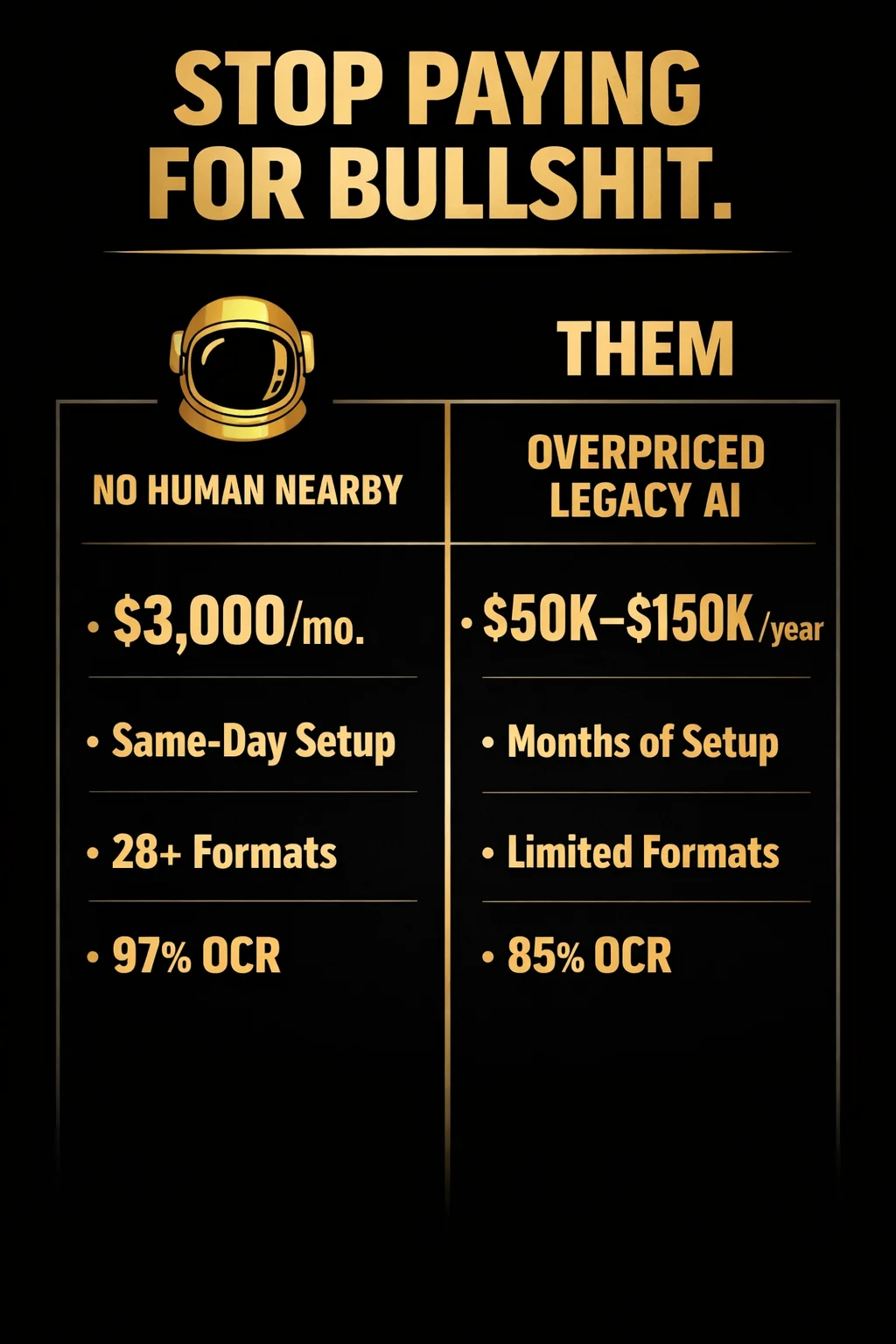
Older marketing collateral that referenced "$3,000 per month flat" is retired. The current rate is $1,990 per seat per year for the software, with the optional one-time hardware spend above. Founder tiers below the standard rate are listed in the Founder Hero card.
Procurement teams cross-verify pricing across web, email, deck, and Stripe. The numbers above are the only authoritative quote and they appear nowhere else in any other shape.
Milestone 1
Request the IT Procurement Pre-Sale Kit. Your current tier rate freezes through the IT audit phase. No calendar clock.
Rate locked: current tier, through IT audit
Milestone 2
IT clears the deployment on the firm's existing SOC 2 or equivalent checklist. Rate freezes through partner vote.
Rate locked: through partner vote
Milestone 3
Partners approve. Rate locked through license activation. Slot is yours at the rate that was current when the champion started.
Rate locked: through license activation
Zero-trust review takes as long as it takes. Reward forward momentum, not the passage of time. Start the procurement process today, lock the current tier rate, and work through your firm's approval cadence without a countdown clock in the background.
Compliance Grace Period Token
We are so confident in our local inference architecture that we actually want you to test it thoroughly.
If your committee review drags due to internal bureaucracy, the internal champion can request a Compliance Grace Period Extension Token. The founding firm slot is maintained while your firm completes its audit cadence. No political capital spent on calendar pressure.
No phone call. No "we will get back to you." The internal champion clicks a button.
Founding Firm Admin · Davis & Reed LLP
Tier locked: Pioneer ($799/seat-yr)
Milestone 1
Download The IT Kit
✓ Complete · 2026-04-12
Milestone 2
Pass IT Audit
In progress · week 6 of 8
Milestone 3
Partner Vote
Not started
Compliance Grace Period Token Available
Internal IT review extending past 60 days? One-click extends the rate-lock window through the end of next quarter. Auto-applied; no NHN approval needed.
Tokens consumed: 0. Tokens remaining this contract: 2 (max). Auto-extend window: 90 days per token.
Step 1
Champion logs into the admin portal at the start of the audit cycle. Tier rate is already locked.
Step 2
If review drags past 60 days, the Apply Extension Token button activates. Champion clicks once.
Step 3
Window extends 90 days, audit-trail entry signed by NHN, rate stays at the locked tier.
Up to two extension tokens per contract (180 days of grace), no questions asked. Token consumption is logged in the firm's procurement audit trail; NHN does not gate it on internal review.
Once they're gone, it's full price. Lock in your rate before the next tier fills.